Intercom Integration
Connect ProductBridge to Intercom to automatically capture feedback from support conversations and let your team submit feedback directly from the Intercom sidebar.

Where to find it
Open Intercom in ProductBridge
Sidebar → Connect Sources → Intercom
Direct link: https://app.productbridge.io/dashboard/settings/integrations/intercom
In-app path: Sidebar → Connect Sources → Intercom
Requires: integration:view to see the integration, integration:manage to connect or disconnect it.
All integrations: https://app.productbridge.io/dashboard/settings/integrations
Overview
The Intercom integration connects your Intercom workspace to ProductBridge so you can capture product feedback at the moment it surfaces — without leaving Intercom. Once installed, the ProductBridge app appears inside Intercom as a sidebar app, and every closed conversation is analyzed by AI to extract feature requests, bug reports, and pain points automatically.
There are two ways feedback flows from Intercom into ProductBridge:
-
Sidebar App — Support agents create feedback posts directly from the Intercom conversation panel
-
Conversation Analysis — When a conversation is closed, the entire conversation is sent to ProductBridge, analyzed by AI, and turned into a feedback post if it contains product input
Prerequisites
-
An Intercom workspace with admin or app management permissions
-
A ProductBridge organization with at least one feedback board configured
-
Permission to install apps in your Intercom workspace
Connect Intercom
Open the Integrations catalog
Sign in to your ProductBridge dashboard and click Connect Sources in the sidebar to open the Integrations catalog.
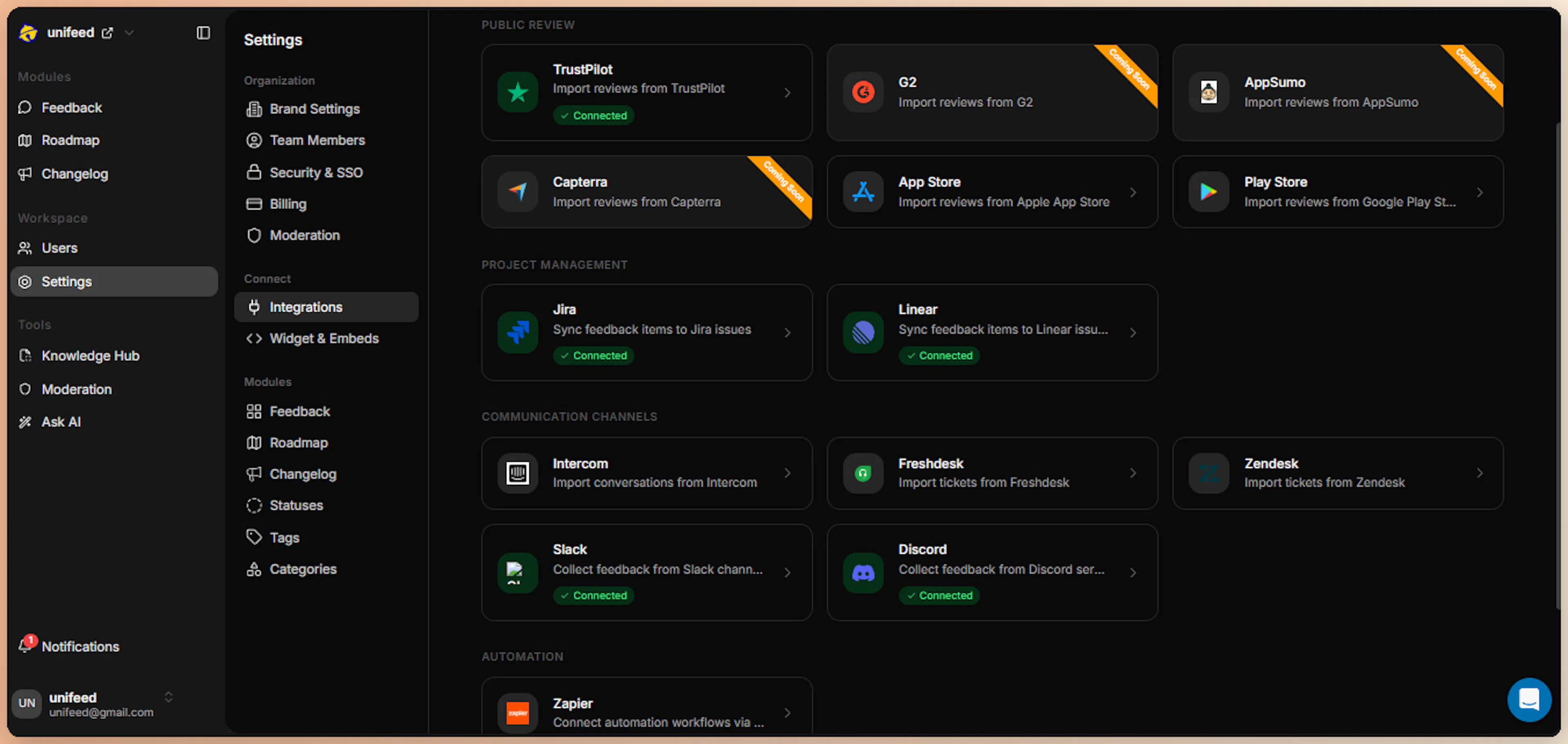
Click on the Intercom Integration
In the catalog, find the Intercom card and open it. Before connecting, you can optionally enable Import historical data and choose a window between 1 and 30 days — this is off by default. Then click Connect to start the Intercom OAuth flow.
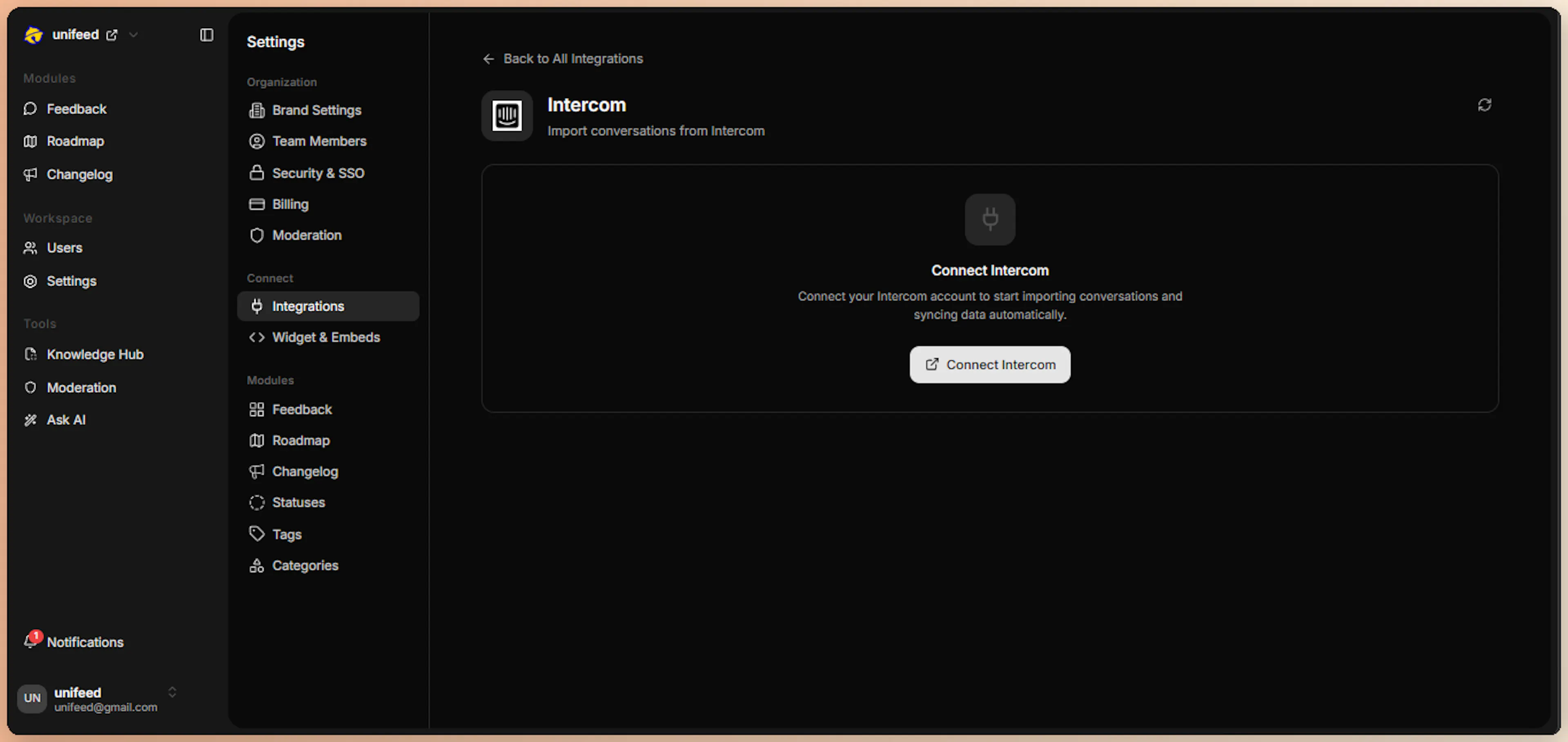
Authorize ProductBridge in Intercom
You are redirected to Intercom's OAuth authorization page. Sign in to Intercom (if needed) and review the permissions ProductBridge requests — read access to conversations, contacts, and tags, plus permission to register webhooks.
Click Authorize Access to install the ProductBridge app into your Intercom workspace.
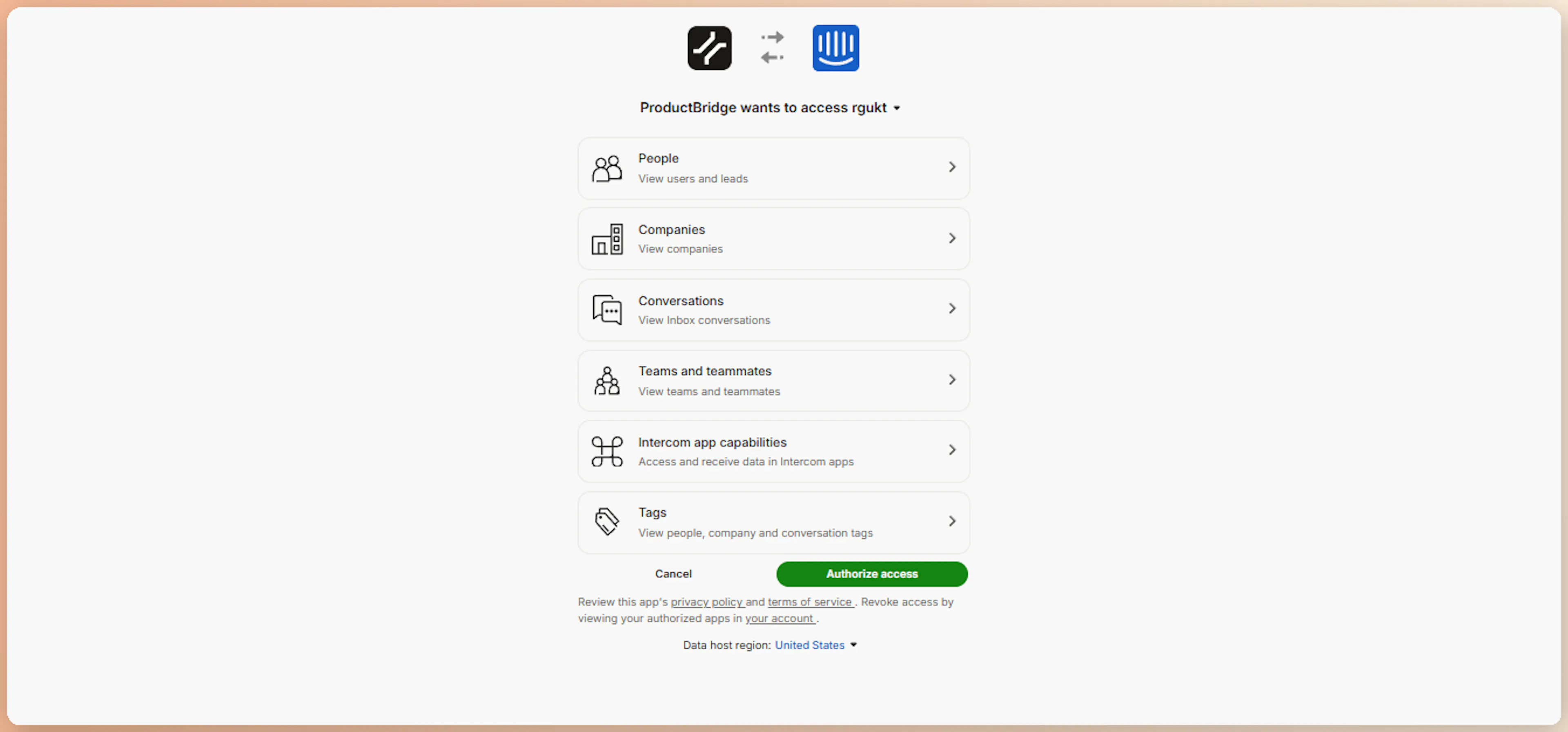
Use a service account rather than a personal Intercom account so the connection persists if team members leave.
Confirm Connection
After authorization, Intercom redirects you back to ProductBridge. The integration status updates to Connected, and ProductBridge:
-
Stores your encrypted Intercom credentials
-
Registers a webhook for the
conversation.admin.closedevent -
Starts a historical import of closed conversations from your chosen window — only if you enabled Import historical data before connecting
-
Installs the ProductBridge sidebar app in your Intercom workspace
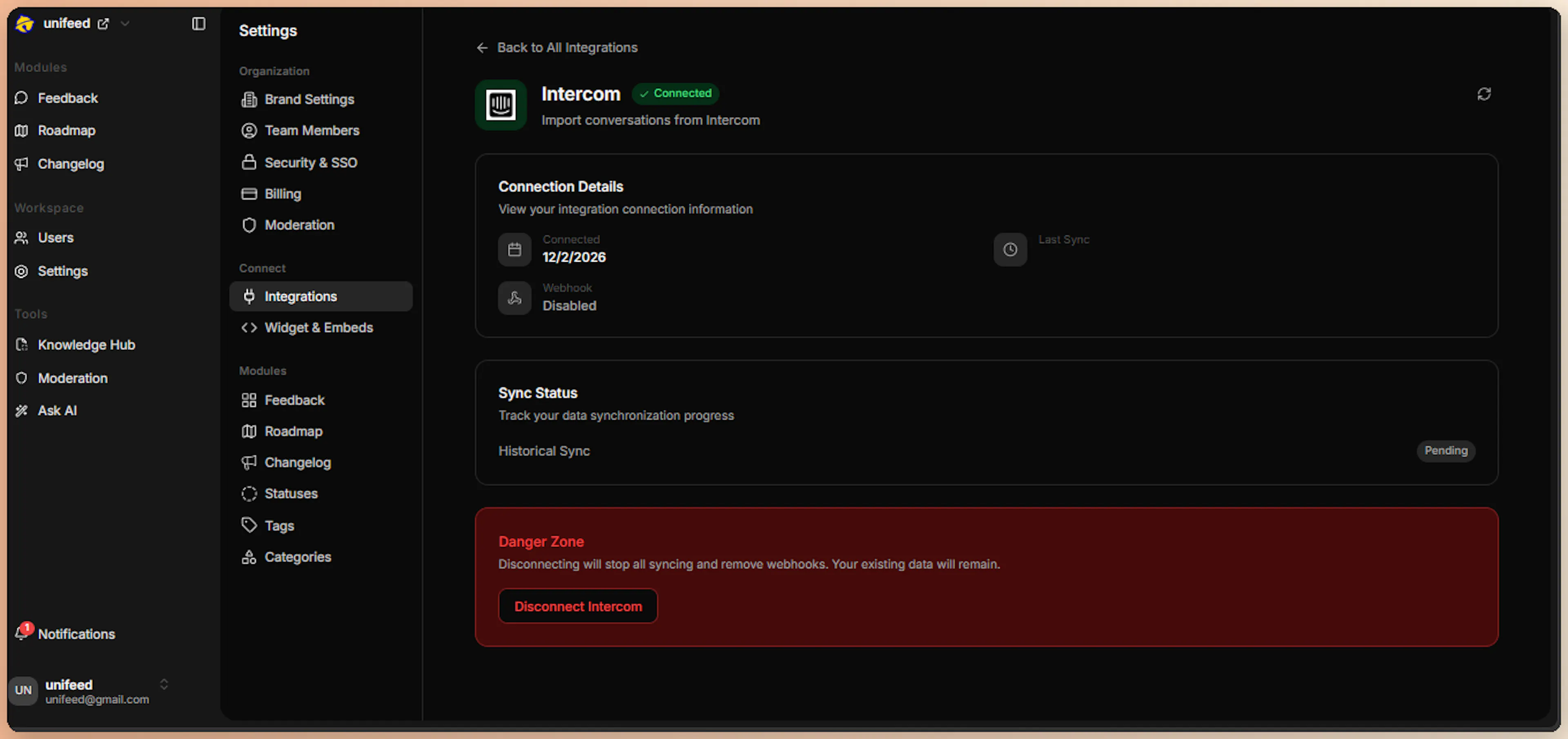
Submit Feedback from Intercom
After installation, your team can capture feedback in two ways.
1. Sidebar App — Create Feedback Manually
When the ProductBridge app is installed, it appears in the conversation details panel (right sidebar) of every Intercom conversation. Support agents can search existing feedback, vote on posts, or create a new feedback post directly from the conversation they are working on — no context switching.
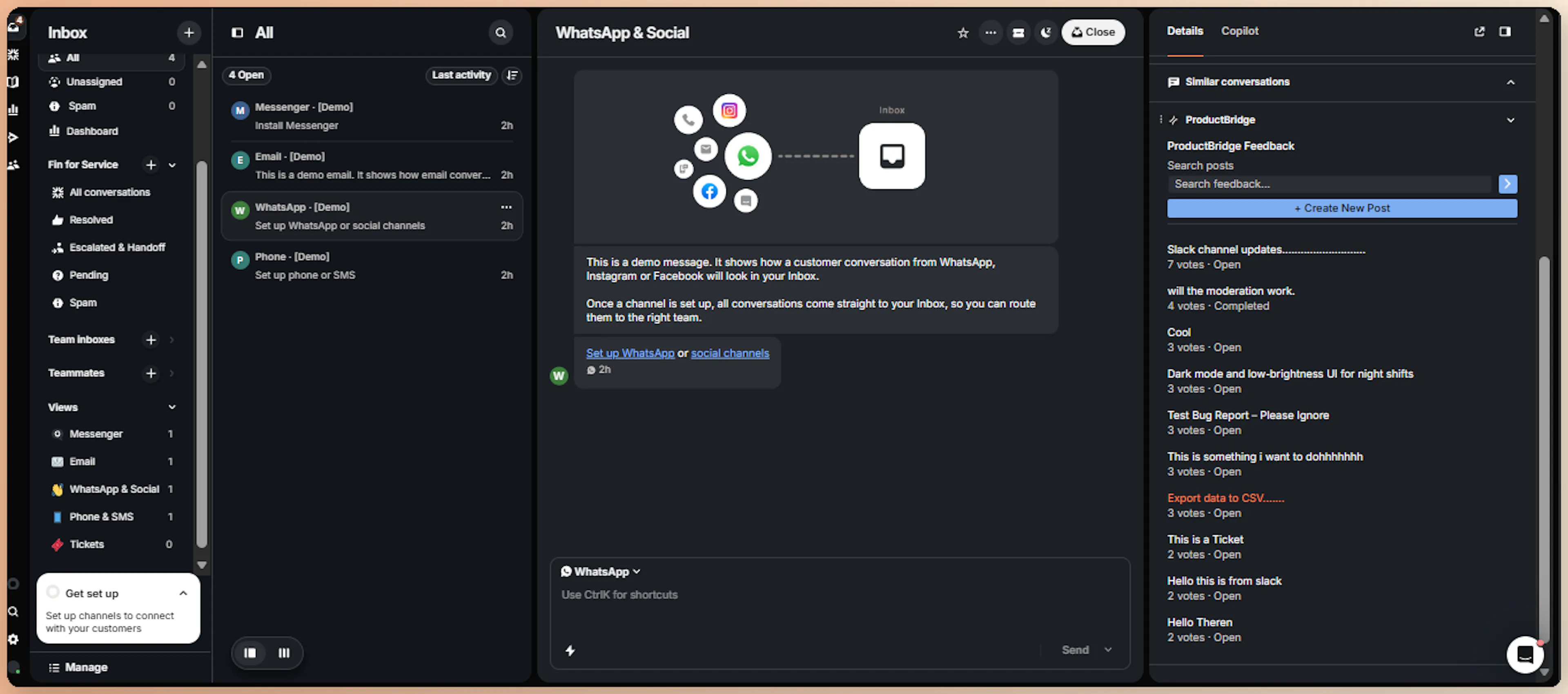
How it works:
Open a Conversation in Intercom
Navigate to any conversation in Intercom Inbox. The ProductBridge sidebar app appears in the right panel with your 10 most recent feedback posts.
Search or Create
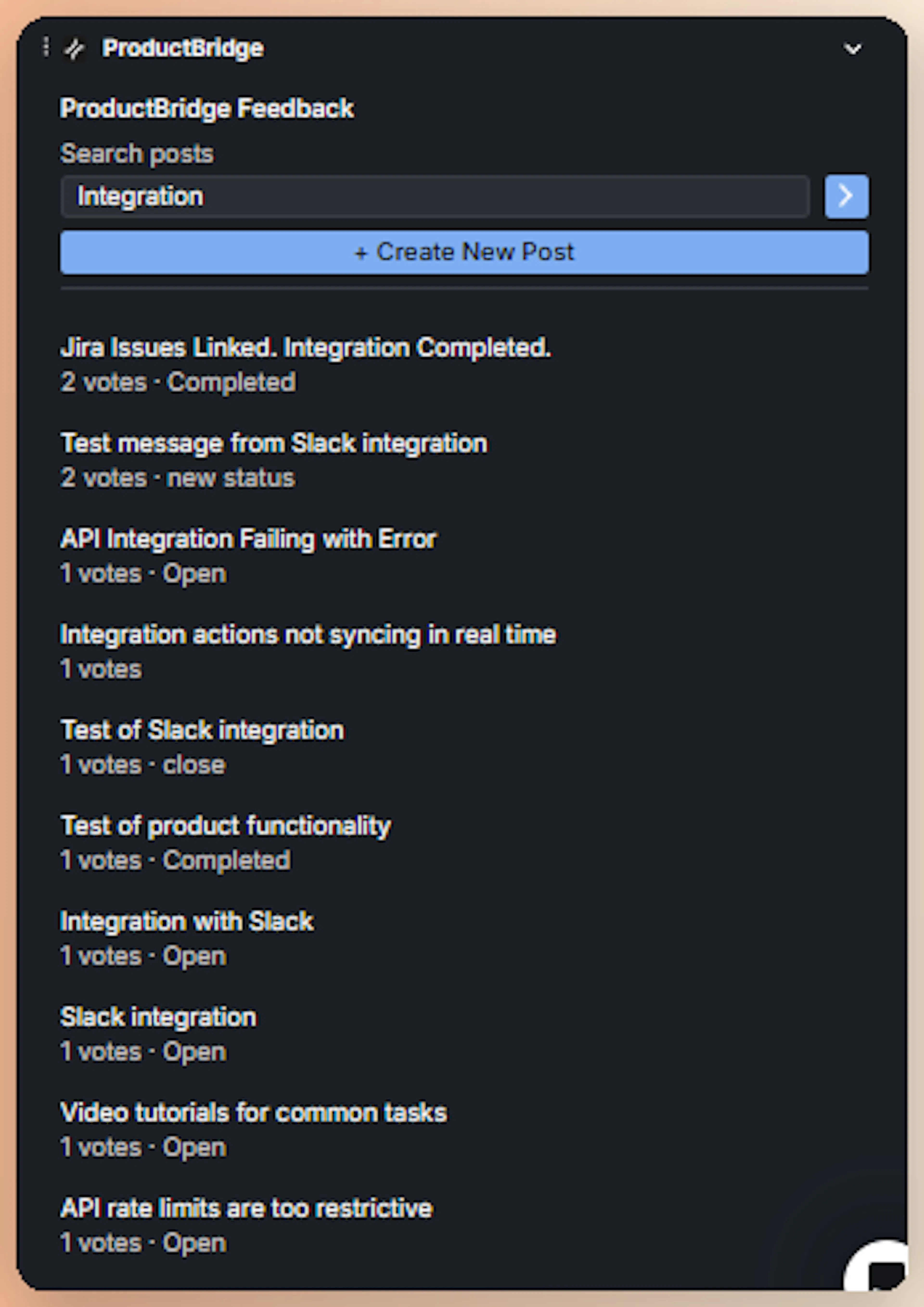
Use the search bar to check whether the user's input is already a known feedback item. If it exists, click the post to view details and add a vote. If not, click Create New Post.
Fill the Form
Select a target board, enter a title, and add a description. The form pre-fills the customer context from the active Intercom conversation, so authorship and source metadata are linked automatically.
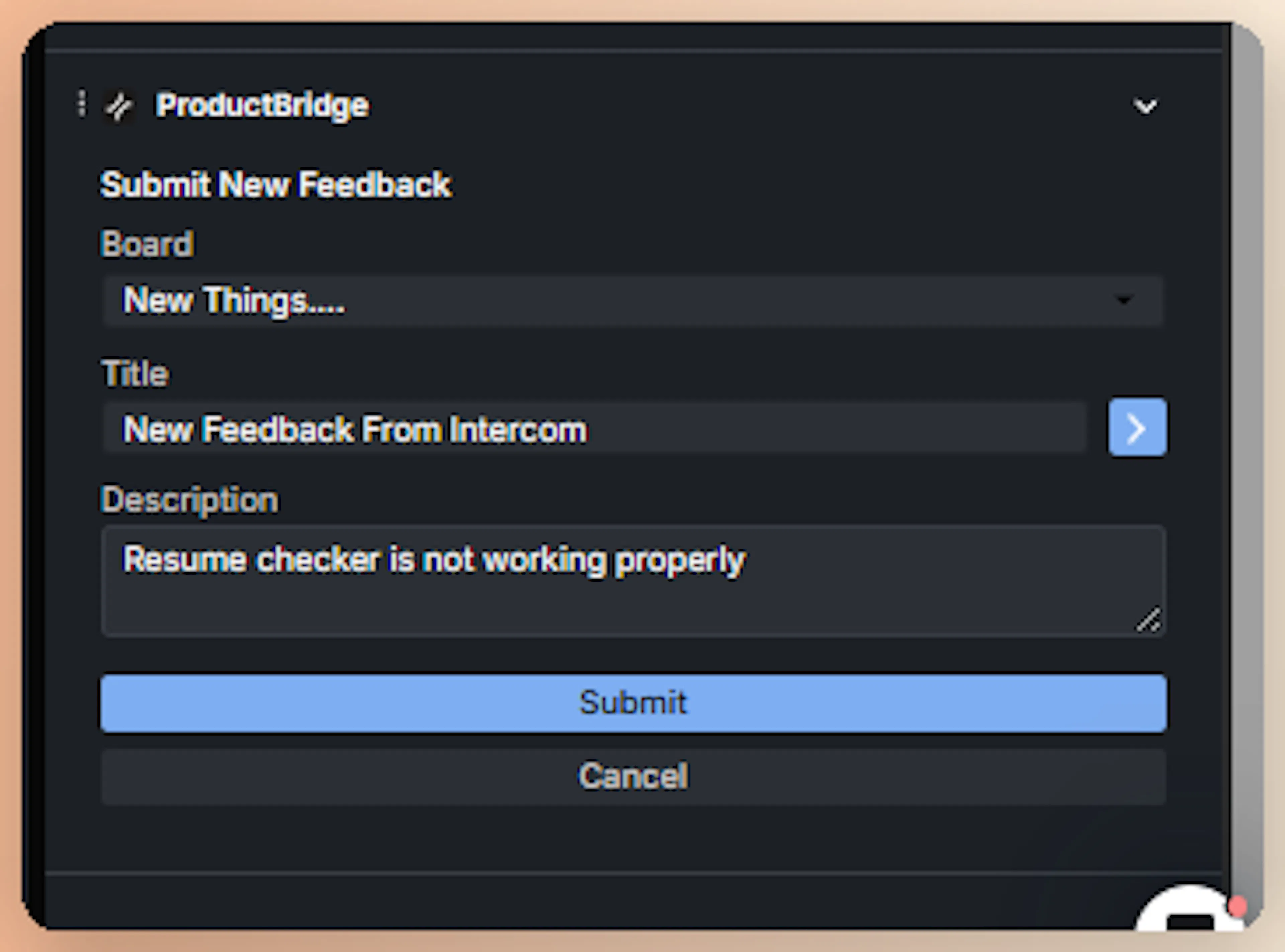
Submit
Click Submit. The post is created instantly with source: intercom and source_type: manual, and is auto-approved (since a teammate created it). The contact details from Intercom are attached as the post author.
2. Conversation Analysis — Automatic Feedback Capture
When a support conversation is closed in Intercom, ProductBridge receives a webhook with the conversation ID, fetches the full conversation, and runs it through an AI pipeline that decides whether the conversation contains product feedback. If it does, a feedback post is created automatically.
The AI pipeline runs five stages:
| Stage | What Happens |
|---|---|
| Normalize | Conversation parts, tags, customer info, and rating are combined into a structured format |
| Detect | LLM determines if the conversation contains product feedback. Confidence scores rise for low ratings, multi-turn discussions, escalations, and feedback-related tags |
| Extract | LLM extracts the feedback title, description, sentiment, priority, feature area, and pain points |
| Deduplicate | Semantic search (Qdrant) checks for similar existing posts. If similarity ≥ 0.85, ProductBridge votes on the existing post instead of creating a duplicate |
| Organize | LLM assigns the right board, category, and tags |
Feedback created via conversation analysis is tagged with source: intercom and source_type: integration. The original Intercom conversation URL is stored in the post's metadata for traceability.
Priority adjustments specific to Intercom:
-
Enterprise customers receive higher priority weighting
-
Conversation ratings of ≤2 stars boost priority
-
Admin-escalated conversations are flagged as urgent
-
Bug reports and performance issues are bumped one tier
Historical Import
Historical import is optional and off by default. When connecting, toggle on Import historical data and pick a window between 1 and 30 days to backfill closed conversations from that period. Each imported conversation is queued for AI analysis and creates a feedback post if it contains feedback. You see progress in the integration settings page.
If you leave the toggle off, ProductBridge only processes conversations that are closed after you connect.
Historical import runs in the background and can take from a few minutes to several hours depending on conversation volume. New conversations from the moment of connection onward are processed in near real time via webhooks.
Disconnect
To disconnect Intercom, open Connect Sources > Intercom and click Disconnect. ProductBridge:
-
Removes the registered webhook from Intercom
-
Marks the integration as
disconnected -
Stops all ongoing import or processing tasks
Existing feedback posts remain in ProductBridge — only the live connection is removed.